
Please ensure Javascript is enabled for purposes of website accessibility

Economic Impacts and Policy Considerations for Data Center Development in Michigan

Prepared for Michigan Chamber Foundation, in partnership with the Detroit Chamber

June 25, 2026

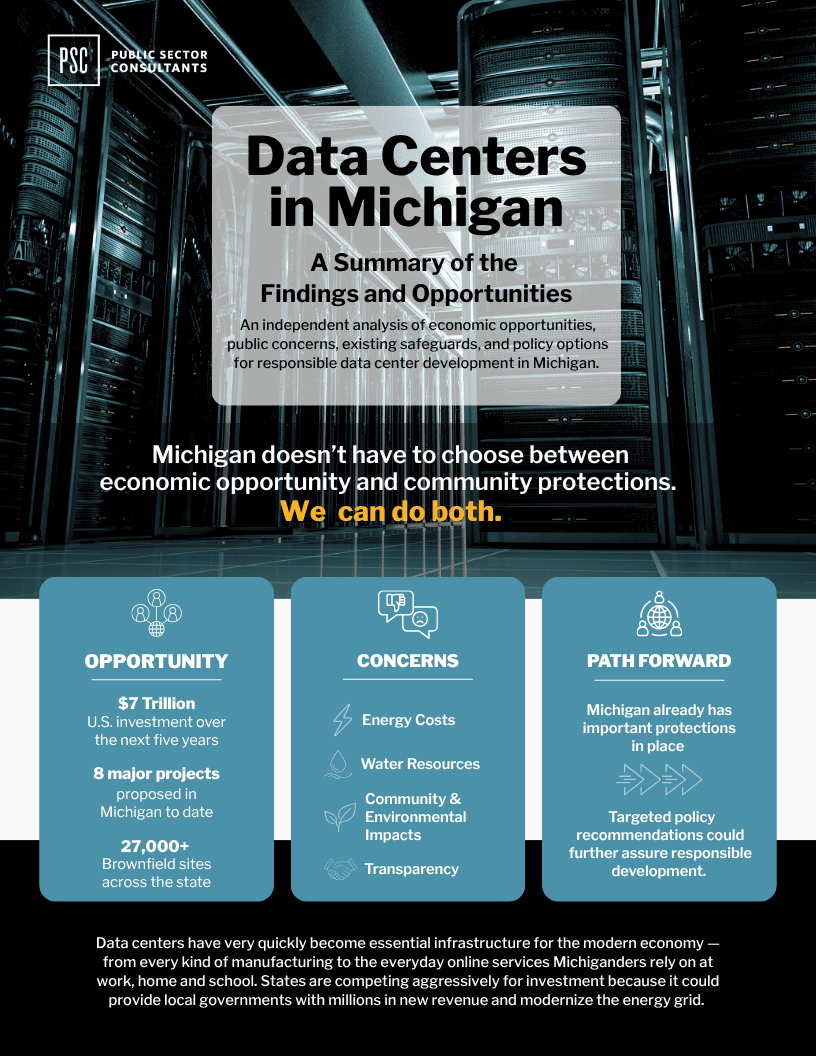
Companies have traditionally relied on physical facilities to house the data and computing equipment that support e-commerce, online banking, video conferencing and collaborative tools. With the increase in demand for digital connectivity and the speed and pace of technological advances, Michigan has an opportunity to attract significant new investments into the state through data center development. With a projected $7 trillion in investment flowing into data center infrastructure, this is an opportunity to attract a share of that growth while ensuring development is responsible and reflective of the state’s values.

One of the major hurdles for the state will be the public’s negative sentiment towards hyperscale data centers. The good news is that many of the issues the public has raised are already addressed within Michigan’s current regulatory framework and companies have issued public pledges to operate in a way that mitigates these concerns. Our report presents a set of recommendations to enhance Michigan’s regulatory framework and address the public’s primary concerns, including safeguarding Michiganders from utility rate increases, protecting Michigan’s environment, and enhancing transparency around data center development. 
Report Snapshots

Download Full Analysis

This content is made possible by in-depth research and analysis conducted by PSC. Please consider providing some additional information to download this content so we can let you know about other relevant research we’re conducting. We will never share your information with other organizations.

This field is for validation purposes and should be left unchanged.
Name
This field is hidden when viewing the form

Policy Recommendations

This report presents a set of recommendations to enhance Michigan’s regulatory framework and address the public’s primary concerns, including safeguarding Michiganders from utility rate increases, protecting Michigan’s environment, and enhancing transparency around data center development. A summary of these policy recommendations follows.

Maximize the Economic Benefits

  • When offering incentives like property tax exemptions to attract a data center, Michigan should ensure that those incentives lead to additional investment and high-technology jobs beyond the data center’s own operations. While data centers create positive economic impacts, their greatest potential economic benefit is attracting other high-tech investment and jobs. For example, the state could offer a PA 198 property tax abatement to a data center if its operator invests in projects outside the data center that create more high-tech jobs, such as a research lab.

Protect Ratepayers

  • The Michigan Public Service Commission (MPSC) should continue following best practices to protect customers from rate increases when approving projects for high-energy customers such as hyperscale data centers. In addition, publicly disclosing the details of these protections will help build consumer confidence around data center investments.
  • Lawmakers should enshrine ratepayer protection best practices already utilized and followed by the regulated utilities into state law so that the same regulatory standards are applied to all data centers. This would ensure utility or data center projects outside the MPSC’s scope would still have adequate rate payer protections and energy accounting in place. Concerns that data centers raise electricity rates are causing public opposition. Michigan’s regulated utility market and the MPSC already have safeguards in place to prevent data center–related utility hikes, but more should be done to make the public aware of these protections—enshrining them in state law would provide an added level of confidence.

Protect Michigan’s Environment

  • Require any data center directly drawing groundwater to use a low-water-usage cooling technology.
  • Consider amending the water requirement in Michigan’s enterprise data center sales tax exemption to allow low-water-usage technologies in addition to municipal water as a means of qualifying for the sales tax exemption. The municipal water requirement is in place to address concerns about data centers that use millions of gallons of water per day. However, there is technology that drastically reduces water usage. Mandating any groundwater-using data center to adopt low-water-usage technologies will minimize the impact of data centers on Michigan’s watershed.
  • Create incentives for data centers to locate on brownfields and former industrial sites. These incentives could include assisting in land assembly, providing direct grants, expanding brownfield tax increment financing (TIF) capture eligibility, or restoring Michigan’s brownfield business tax credit. Michigan has many abandoned industrial sites that can be repurposed for data centers and Michigan should encourage this use.

Increase Transparency

  • Consider additional public engagement processes, including how to incorporate the investments in improving the community where the data center is located.
  • Limit NDA use by governments and public officials and consider restricting information included in NDAs, requiring expiration dates on NDAs, or adding transparency requirements such as disclosing the presence of NDAs within 30 days of the NDAs being signed. NDAs and the resulting secrecy often undermine public trust. They also make it difficult to compare projects and identify and implement best practices. While an NDA may help advance an individual project, collectively they are harming public support for Michigan data centers. Michigan should look for the best way to provide transparency around data center development while still allowing companies to protect trade secrets.
  • Require the Michigan State Tax Commission to publish property tax guidance for data centers to help taxpayers and communities understand how much property tax a data center will pay.
  • Consider exempting hyperscale data centers from property tax and instead applying a newly created specific tax or have communities secure property tax guarantees with data centers to create more certainty around tax payments. The property taxes paid by data centers are an important benefit to local communities. However, it is difficult to discern how much property tax individual data centers will pay. Steps that add certainty can build public support now and reduce future conflict.

For more details on the four recommendations listed above and other insights from this report, download the full report.