
Please ensure Javascript is enabled for purposes of website accessibility

Michigan's Water Infrastructure Funding Gap

October 21, 2026

Michigan is defined by water.  But the infrastructure that delivers safe drinking water, treats wastewater, manages stormwater, and holds back floodwaters is aging faster than it can be replaced, and the cost of that neglect is growing.

At the request of the chair of the Michigan Senate Appropriations Committee, and with grant support from the Charles Stewart Mott Foundation, the University of Michigan Water Center and Public Sector Consultants conducted nonpartisan research to build the first holistic view of Michigan’s water infrastructure needs. Drawing on more than 60 reports, surveys, and analyses, this report examines six categories through a One Water lens: source water protection, private wells and septic systems, gray infrastructure, stormwater, water assistance, and dams.
Download Full Analysis

This content is made possible by in-depth research and analysis conducted by PSC. Please consider providing some additional information to download this content so we can let you know about other relevant research we’re conducting. We will never share your information with other organizations.

This field is for validation purposes and should be left unchanged.
Name

Adding this field is all you need to do, there's no other configuration required. You will not see this field on the frontend of your website.

Looking Ahead

For decades, federal dollars covered the majority of water infrastructure costs. Today the federal share has fallen to about 7 percent, shifting the burden onto local ratepayers, and the cost of water service in Michigan has already risen 188 percent (inflation adjusted) since 1980. With temporary federal funding winding down, Michigan faces a choice: invest proactively now, or pay far more later as systems fail. Closing the gap will require a cohesive, sustained state funding strategy, better data on the infrastructure we cannot see, and a commitment to treating water as the connected system it is, from source to tap.

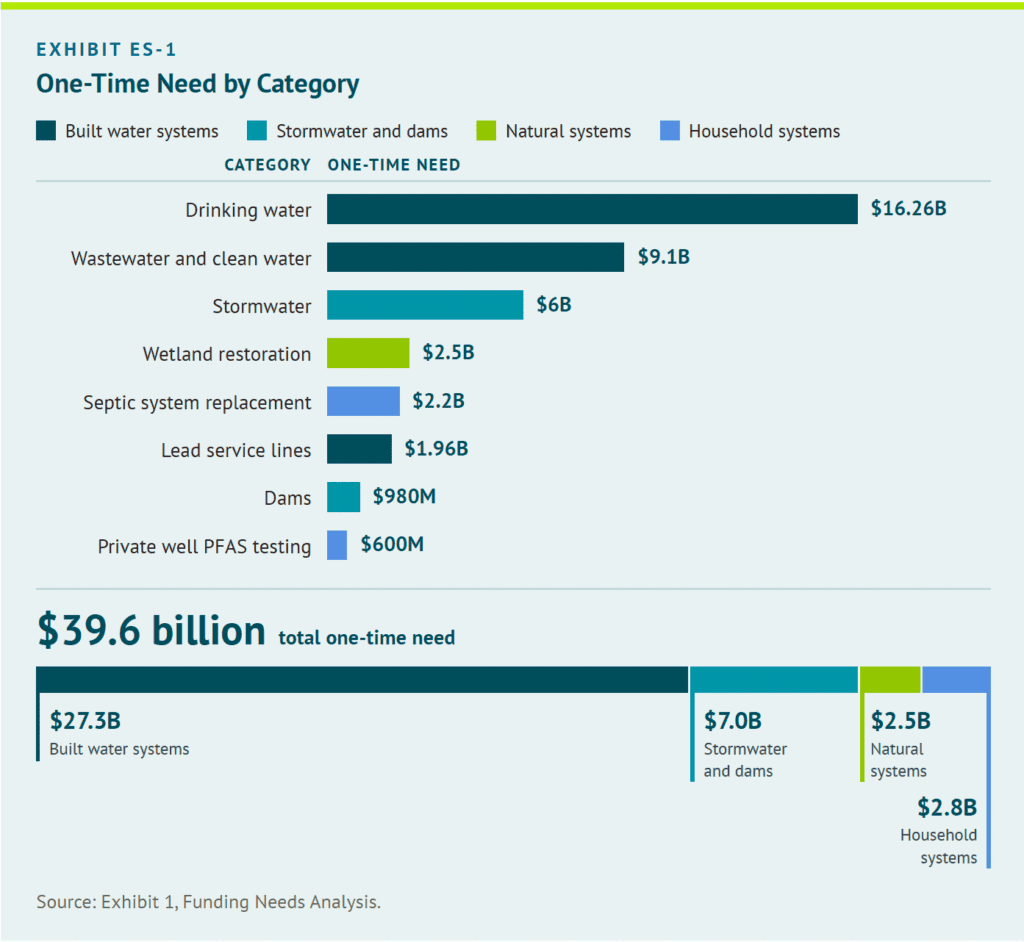
Michigan needs at least $39.6 billion to bring its water infrastructure to a state of good repair, and that’s only what’s been measured. Download the full report to see where the biggest gaps are and why the true cost is even higher.

The graph below shows an assessment of where funding is needed based on category. 

Graph from report describing funding needs based on category